Market calendar: the 24 solar terms and what is in season
The Chinese calendar splits the year into 24 solar terms. Here they are with their dates, festival foods and the local vegetables of each season.
What are the 24 solar terms?
The old Chinese calendar divides the Sun's yearly path across the sky into 24 equal parts, one every 15 degrees of the Sun's longitude. Each point is a solar term (節氣). According to the Hong Kong Observatory, the solstices and equinoxes were the earliest terms fixed in ancient times, followed by the four that mark the start of each season: Spring Commences, Summer Commences, Autumn Commences and Winter Commences. The rest were named after the weather and farm work of each season.
The Observatory notes that the names reflect, to some extent, the climate of central China in ancient times, not Hong Kong today. The terms were all written into the Chinese calendar with the Taichu Calendar of 104 BC, and in 2016 UNESCO listed them as intangible cultural heritage.
Because the terms follow the Sun, their dates barely move in the Western calendar. At the Vernal Equinox and the Autumnal Equinox, day and night are equal in length.
The 24 terms and their dates
English names are the Hong Kong Observatory's. Dates are the usual ones and can shift by a day.
| Usual date | Solar term | Sun's longitude |
|---|---|---|
| 4-5 Feb | 立春 Spring Commences | 315° |
| 18-19 Feb | 雨水 Spring Showers | 330° |
| 5-6 Mar | 驚蟄 Insects Waken | 345° |
| 20-21 Mar | 春分 Vernal Equinox | 0° |
| 4-5 Apr | 清明 Bright and Clear | 15° |
| 20-21 Apr | 穀雨 Corn Rain | 30° |
| 5-6 May | 立夏 Summer Commences | 45° |
| 21-22 May | 小滿 Corn Forms | 60° |
| 5-6 Jun | 芒種 Corn on Ear | 75° |
| 21-22 Jun | 夏至 Summer Solstice | 90° |
| 7-8 Jul | 小暑 Moderate Heat | 105° |
| 22-23 Jul | 大暑 Great Heat | 120° |
| 7-8 Aug | 立秋 Autumn Commences | 135° |
| 23-24 Aug | 處暑 End of Heat | 150° |
| 7-8 Sep | 白露 White Dew | 165° |
| 23-24 Sep | 秋分 Autumnal Equinox | 180° |
| 8-9 Oct | 寒露 Cold Dew | 195° |
| 23-24 Oct | 霜降 Frost | 210° |
| 7-8 Nov | 立冬 Winter Commences | 225° |
| 22-23 Nov | 小雪 Light Snow | 240° |
| 7-8 Dec | 大雪 Heavy Snow | 255° |
| 21-22 Dec | 冬至 Winter Solstice | 270° |
| 5-6 Jan | 小寒 Moderate Cold | 285° |
| 20-21 Jan | 大寒 Severe Cold | 300° |
Festival food through the year
- Ching Ming Festival (清明): falls on the solar term Bright and Clear, on 4, 5 or 6 April. It is a public holiday in Hong Kong, when families visit and clean their ancestors' graves and leave offerings of food.
- Tuen Ng Festival: the fifth day of the fifth lunar month, usually late May or early June, and a public holiday in Hong Kong. People eat zongzi, glutinous rice and fillings wrapped in reed or bamboo leaves in a pyramid shape.
- Mid-Autumn Festival: the 15th day of the eighth lunar month, usually September or early October (25 September in 2026). In Hong Kong the next day is a public holiday. Neighbourhoods put on lantern displays, and boxes of mooncakes, a rich pastry often filled with sweet bean or lotus seed paste, are given as gifts.
The winter solstice dinner
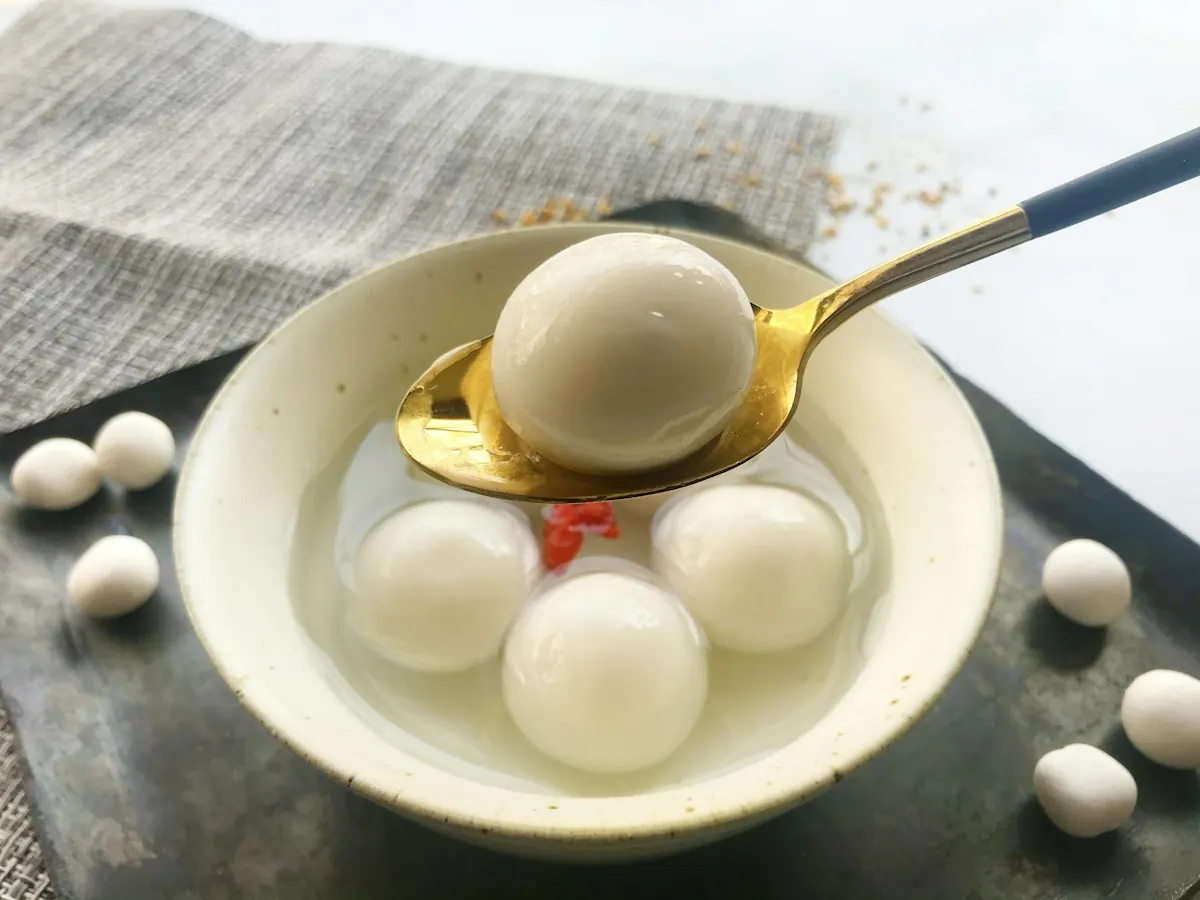
Dongzhi (冬至), the Winter Solstice term, starts when the Sun reaches 270°, on 21 or 22 December. It was the first solar term ever fixed and was traditionally a very important holiday, comparable to Chinese New Year. In Hong Kong it is a time for families to eat dinner together, and many businesses let staff leave work early. A common dish is tangyuan, balls of glutinous rice in sweet soup that stand for reunion. Read more about tangyuan in our sweet soup guide.
What is in season at the market
Hong Kong's Agriculture, Fisheries and Conservation Department (AFCD) groups local vegetables by the season they grow in:
- All year: Chinese white cabbage, flowering Chinese cabbage, lettuce and celtuce.
- Summer: long beans (yard-long beans), water spinach, Chinese spinach, cucumber and several Chinese gourds, including bitter cucumber and hairy gourd.
- Cooler months: spinach, watercress, Chinese kale and matrimony vine, with chayote among the winter-spring crops.
For tips on shopping, read our Hong Kong wet market guide.
Frequently asked questions
What are the 24 solar terms?
They are 24 points in the solar year, one for every 15 degrees the Sun moves along its yearly path. Their names reflect the climate of central China in ancient times.
When is Dongzhi in Hong Kong?
Dongzhi, the winter solstice, falls on 21 or 22 December. Families eat dinner together and many businesses let staff leave early.
Which vegetables grow in Hong Kong in summer?
The AFCD lists long beans, water spinach, Chinese spinach, cucumber and several Chinese gourds as summer crops.
- Hong Kong Observatory, The 24 Solar Terms: https://www.hko.gov.hk/en/gts/time/24solarterms.htm
- Wikipedia, Solar term: https://en.wikipedia.org/wiki/Solar_term
- Wikipedia, Qingming Festival: https://en.wikipedia.org/wiki/Qingming_Festival
- Wikipedia, Dragon Boat Festival: https://en.wikipedia.org/wiki/Dragon_Boat_Festival
- Wikipedia, Mid-Autumn Festival: https://en.wikipedia.org/wiki/Mid-Autumn_Festival
- Wikipedia, Dongzhi Festival: https://en.wikipedia.org/wiki/Dongzhi_Festival
- Agriculture, Fisheries and Conservation Department, Annual Report 2008: Agriculture: https://www.afcd.gov.hk/misc/download/annualreport2008/en/agriculture.html
- AFCD, Local common vegetables: winter-spring crops: https://www.afcd.gov.hk/english/agriculture/agr_useful/agr_useful_local/agr_useful_local_win.html
- AFCD, Local common vegetables: summer crops: https://www.afcd.gov.hk/english/agriculture/agr_useful/agr_useful_local/agr_useful_local_sum.html